Wednesday, September 16, 2009

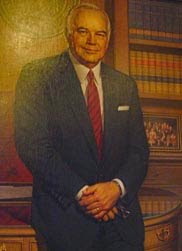
Governors: Norman Howard Bangerter

NORMAN HOWARD BANGERTER
1933–
Norman Howard Bangerter was born in 1933 in rural Salt Lake County. For 50 years, with the exception of his college and army days, he lived less than ten blocks from the farmhouse where he was born. He attended the University of Utah and Brigham Young University before serving in the U.S. Army in Korea from 1953–54.

Bangerter began his career as a contractor and over the years became a successful home builder and real estate developer. He entered politics in 1974 after winning a seat in the Utah House of Representatives. His leadership skills helped him become the first Speaker of the House to serve two terms in over 40 years. He became governor in 1984—the state’s first Republican Governor in 20 years. Bangerter outlined his administration’s top priorities, which he called the “Three Es”—education, economic development, and efficiency in government. A fourth “E”, for environment, was added a few years later.

Facing economic difficulties, Bangerter campaigned aggressively to rebuild the state’s economy and successfully recruited new businesses and industries to the state. By his second term, Utah’s economy was growing even during a national recession. During his eight years in office, Bangerter oversaw the establishment of the State Court of Appeals, increased funding and higher test scores for Utah schools, the construction of a performing arts building at the University of Utah and new facilities at the state prison.

ARTIST

E. Keith Eddington (1923–2007) was born in Philadelphia and raised in Lehi, Utah. He served in World War II in both the European and Pacific theaters. Eddington studied art at the University of Utah and was the student of famous artists Arnold Friberg and Alvin Gittins. He later joined the faculty at the University of Utah where he taught for 20 years. During his successful career, he also taught at Brigham Young University and was the head of Keith Eddington and Associates, a highly respected graphic design firm in Salt Lake City. During his retirement, he continued to paint portraits.

Tuesday, September 15, 2009

Governors: Scott Milne Matheson

SCOTT MILNE MATHESON
1929–1990
Scott Milne Matheson was born in Chicago, Illinois in 1929. During the early 1930s, his family moved to Parowan, Utah and then later moved to Salt Lake City. He attended East High School and then University of Utah before graduating from Stanford University Law School in 1952. Matheson practiced law in Cedar City for several years and then moved to Salt Lake City to work as the deputy attorney for Salt Lake County. He then worked for the legal department of the Union Pacific Railroad.

An active member of the Democratic party since college, Matheson ran for governor in 1976 and won, making him one of the few Democrats to win that year. At his inauguration, Matheson declined the traditional military cannon salute to emphasize his inaugural address, which stressed the need to use Utah’s resources wisely and to protect the environment.

Matheson faced many challenges during his two terms as governor: devastating drought, increasing population, growing inflation, spiraling Medicaid costs, and fast-growing enrollment in schools. Matheson successfully protested the location of an MX missile system in Utah and the transfer of nerve gas bombs to the state. Because environmental issues were important to Matheson, he opposed nuclear waster dumps in Utah. Three-thousand acres of the Deep Creek Mountains is named Scott’s Basin in honor of Matheson’s conservation efforts. Matheson had the foresight to see that computer technology would play an important role in the future and requested funds for the state to own and manage its own data processing system.

ARTIST

Alvin L. Gittins (1922–1981), one of Utah’s finest painters, came from England to study art at Brigham Young University. He later taught for many years at the University of Utah. Gittins was Utah’s most dominant portrait painter and was noted for his ability to capture his subject’s personality, as well as likeness, and for his masterly traditional styles. He also painted Governor Rampton’s portrait.

Monday, September 14, 2009

Governors: Calvin Lewellyn Rampton

CALVIN LEWELLYN RAMPTON
1913–2007
Born in 1913, Calvin Lewellyn Rampton was Utah’s third governor elected from Davis County. He attended the University of Utah and served in the Utah National Guard during World War II in Europe where he received a Bronze Star. Rampton’s early career was spent as the Davis County Attorney and the assistant attorney general for Utah. A lifelong Democrat, Rampton ran unsuccessfully for the United States Senate in 1954 and 1962. Although discouraged by these losses, he accepted his party’s nomination for governor and won that office in 1964.

Rampton asked the Legislature for increased spending for education, passage of three civil rights bills, and the right to use federal funds for urban renewal, and the Legislature responded favorably to a majority of his requests. The 1967 Legislature approved $117 million for higher education, more than Rampton had requested.

Rampton easily won re-election in 1968 and 1972 making him Utah’s first and only governor to serve three full terms. As governor, Rampton worked with business leaders and championed industrial development, tourism, development of energy resources and expansion of the defense industry in Utah. During his third term, he recommended ratification of the Equal Rights Amendment to the U.S. Constitution. He supported state building projects, including Salt Lake City’s Symphony Hall (now Abravanel Hall), the Salt Lake Arts Center, and numerous public schools.

Throughout his three terms in office, “Cal” Rampton remained a popular governor. The Calvin L. Rampton Complex, which houses the Utah Department of Transport and the Utah Department of Public Safety, as well as Cal Rampton Boardroom at the Capitol are named after him. After Rampton’s death in 2007, the Salt Palace Convention Center was renamed the Calvin L. Rampton Salt Palace Convention Center in his honor.

ARTIST

Alvin L. Gittins (1922–1981), one of Utah’s finest painters, came from England to study art at Brigham Young University. He later taught for many years at the University of Utah. Gittins was Utah’s most dominant portrait painter and was noted for his ability to capture his subject’s personality as well as likeness and for his masterly traditional styles. He also painted Governor Matheson’s portrait.

Friday, September 11, 2009

Governors: George Dewey Clyde

GEORGE DEWEY CLYDE
1898–1972
George Dewey Clyde was born in 1898 in Springville, Utah. He earned a master’s degree in civil engineering and taught classes at Utah State Agricultural College (now Utah State University), that focused on hydraulic and fluid mechanics and irrigation methods. He was a successful researcher and published nearly 50 articles in engineering journals. Governor Blood appointed Clyde as the State Water Conservator in 1934, at the height of Utah’s worst drought.
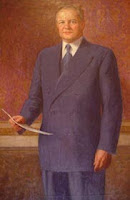
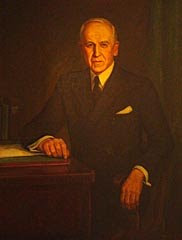
As governor, Clyde emphasized strict economy in government and advocated for states’ water rights against the federal government. Utah saw some great changes during Clyde’s years as governor. He oversaw the construction of a multimillion-dollar interstate highway, the building of the University of Utah’s medical school, and the creation of Canyonlands National Park. He defended minority rights, opposing a “Sunday closing” bill, arguing that not all religions viewed Sunday as the Sabbath. He remained unfailingly dedicated to water projects in Utah during his two terms as governor.

ARTIST

Everett “Ev” Clark Thorpe (1904–1983) began his art career as a sports artist for The Deseret News and The Salt Lake Tribune. In Utah, he studied under LeConte Stewart and Calvin Fletcher. He also studied art at the Los Angeles County Art Institute, Syracuse University, and the Hans Hofmann School of Art in Massachusetts. Thorpe taught art at Utah State University for 40 years, and his work ranged from illustration to portraiture to mural projects. Thorpe painted Governor Clyde in his professional environment, standing in Utah’s arid southwest desert with plans for the Glen Canyon dam in hand.

Thursday, September 10, 2009

Governors: Joseph Bracken Lee

The Utah State Capitol’s first floor will see changes in the upcoming weeks with the addition of biography plaques in the Hall of Governors. A biography plaque will hang next to each portrait of our Utah’s governors. We will be posting an example of what will be on the plaque every day. Stay tuned to read about your favorite Governor!


JOSEPH BRACKEN LEE
1899–1996
Joseph Bracken Lee was born in Price, Utah in 1899. He served in the army during World War I and owned successful insurance businesses and real estate. He began his political career as the mayor of Price, an office he held for 12 years. After Lee made several unsuccessful bids for Congress and governor, he was elected governor in 1948.

Lee gained national attention for his battle against federal income tax and his ideas regarding reform in state government. He made deep cuts in many state agency budgets, despite Utah’s $9 million surplus in the budget. He reorganized the welfare, highway, and education departments and created a state motor pool. A controversial governor, Lee often stated his low opinion of teachers and school administrators, which eventually united the entire educational establishment against him. Despite having some political enemies, Lee’s popularity as governor remained intact enough for him to win a second term.

After losing a bid for a third term, running on the Independent ticket, Lee continued to run for other public offices including senator and mayor. In 1959 he became the mayor of Salt Lake City and served for 12 years. When he retired at age 73, Lee had served an impressive 32 years in elective office for the state of Utah.

ARTIST

C.J. Fox is a mystery to the Capitol Preservation Board. No records remain as to when Governor Lee’s portrait was painted or even what Fox’s first name was.

Wednesday, August 19, 2009

Governors: Herbert Brown Maw

HERBERT BROWN MAW
1893–1990


Herbert Brown Maw was born in Ogden, Utah in 1893. At age 11, he went to work to help support his family by selling newspapers on the streets of Salt Lake City and aluminum pans door to door. He also operated an ice cream stand at the Saltair Resort. While working, Maw continued to go to school, attending LDS High School and the University of Utah Law School. During World War I, he served as an LDS chaplain. Following the war, Maw earned a master’s and law degree from Northwestern University. When he returned to Salt Lake City, he taught political science and speech at the University of Utah. He served as Dean of Men at the University from 1928 to 1936.

In 1928 Maw was elected to the state Senate and served there for ten years, four of which he served as Senate President. He was elected governor in 1940, and quickly reorganized the Executive Branch creating fewer departments, which received bipartisan support from the Legislature. With World War II on the horizon, Maw worked hard to attract military installations and industries to Utah. Utah’s location made it ideal for many wartime facilities, which created thousands of jobs and energized Utah’s economy. Maw served his second term as governor during the transitional period from war to peacetime and supported legislation to help veterans return to civilian life and gain access to housing and education. He was particularly dedicated to improving highway systems so that Utah’s scenic attractions would be more accessible. After losing his bid for a third term, Maw retired to private law practice and maintained office hours well into his nineties, handling many pro bono cases for the poor.

ARTIST

Lee Greene Richards (1878–1950) was a well-known Utah artist who studied with J.T. Harwood and trained in France. In 1904, he received honorable mention at the Paris Salon, making him the first Utah painter to receive this honor. Richards’ artwork can be seen throughout the Capitol with murals in both the rotunda and Senate chamber as well as portraits of Utah governors Spry and Mabey.

Tuesday, August 18, 2009

Governors: Henry Hooper Blood

HENRY HOOPER BLOOD
1872–1942


Henry Hooper Blood was born in Kaysville, Utah in 1872. He worked at a variety of occupations including manager of Kaysville Milling Company. Blood’s public service career began when he was elected as city recorder of Kaysville in 1893. In 1922, Blood was appointed to the State Highway Commission and in 1925 was selected chairman. This position gave Blood administrative experience and introduced him to local officials all over the state, which helped him in his bid for governor in 1932.

Blood served two terms as governor during the Great Depression. Utah’s unemployment rate was 36 percent—the fourth highest in the nation—and in 1934 the state experienced the worst drought in Utah’s history. Blood’s approach to the state’s problems was to drastically cut state expenditures, implement a pay-as-you-go policy, and obtain federal relief dollars through New Deal programs. He was particularly successful in securing funds for Civil Conservation Corps and Works Progress Administration projects, which included murals in the Capitol rotunda. He also worked hard for the construction of dams throughout the state, which provided both jobs and improved area water capacity. Despite his personal opposition to alcohol, Blood supported the repeal of Prohibition in 1933, making Utah the final state necessary for ratifying the 21st Amendment. He was the first governor to live in the Thomas Kearns mansion, which today still serves as the governor’s residence.

ARTIST
Gordon Nicholson Cope (1906–1999) spent much of his career in Utah, training with A.B. Wright and LeConte Stewart before going to Europe to study. He was the head of the art department at LDS University and a teacher for the Work Progress Administration. A gifted painter of both portraits and landscapes, Cope also worked on completing the murals in the Capitol’s rotunda.